Pages

Monday, 24 September 2018

Samarkand - Registan and Tamerlane's tomb.

Although we had seen some beautiful mausoleums, an observatory and a mosque, all with gorgeous facades and beautifully tiled "iwans" (arches), the real drawcard for Samarkand is the Registan.  It was the heart of the city, the earliest building built in 1420 under Ulughbek and the the rest over the next 200 years.  It was a public square where people gathered to hear proclamations, and a place of executions apparently (Wikipedia).


One building of the Registan.  It is to right in the pic above.
It is almost churlish to compare it with the much grander Isfahan in Iran.  But what I did see was what happens when you add gold to the decor.

And the next drawcard is the tomb of Tamerlane.
This is the front:

The dome:

And how they hang together.

And this statue is new - the first president of Uzbekistan.
 

Samarkand - Ulugh Beg Observatory, Mausoleum Complex, and Bibi Kanym Mosque.

We began this morning with a visit to the observatory of Ulug Beg, a renowned astronomer.  It was built in the 1420s, and Ulug Beg was the grandson of Tamerlane.  It seems he was better as an astronomer than as a ruler.

The man himself.


The observatory.  Apparently it still works.  The details escape me, you will have to Google for more info.

This is how it was in the past (thanks to Google).
 Image result for observatory ulugh beg
The museum to Ulugh Beg was built in 1970.

Then we went to the Giri  Amir Mausoleum.  It was a gorgeous collection of mausoleums to famous people.  There was so much beautiful tilework, (pic from Google)
Image result for guri amir mausoleum
that I gave up trying to take photos and went to sit down and have an ice-cream.

Then we saw the Bibi Khanym Mosque.  Another beautifully decorated mosque.
With a magnificent ribbed dome.
Inside
By now, all I wanted to see was the Registan!!!

.

Sunday, 23 September 2018

Bukhara to Samarkand

Today we head to the city of Tamerlane - Samarkand.

Uzbekistan has one thing in  common with Sydney - trains get cancelled and replaced by buses.  It was a 5 hour journey, bumpy at times but the coach was comfortable and we have 2 seats each.

Random roadside pics.  Pretty flat.  We haven't seen a cloud since we have been here. And they drive on the right (wrong) side of the road.


Uzbek ice-cream for sale at our "comfort" stop.

Jobs and growth outside Bukhara - but only one crane.
This is our hotel in Samarkand.

And our room.

And the atrium


which is often used for photo shoots apparently.  There are lots of weddings in Uzbekistan!

Our dinner tonight was at a function centre. Reminiscent of Russia.
 The usual starters - but these were more tasty than usual. Meals are predictable.  This is followed by a substantial soup, the meat course, and dessert, usually a variety of melons.

And the function was in full swing! Hastily taken, but you get the picture.


Bukhara bits and pieces

Money changing is not as easy as some places.  We began to rely on the Bank of Sanjar.
In our hotel there was a hairdryer.  It was built like a tank, and did not have a heat setting, well not one that worked.  I assumed it was Russian, but it was German.  A gym workout while drying your hair!

Bukhara - Fashion and Food


We went for dinner at a former caravanserai, where tables were set around an area - and saw traditional and modern Uzbek clothes.  They were for sale, but I didn't ask the price.

Before the show.
Traditional clothes
Modern version
And some more
And of course, the food.  This is the main course - very substantial.


Thursday, 20 September 2018

Bukhara - Sufi Shrine, Summer Palace and Chor Minor

The Naqshbandi Mausoleum was built for the founder of the Naqshbandi Sufi Order, Khoja Bakhouddin Naqshbandi.  He was the spiritual teacher of Amir Temur (ie Tamerlane).

It seems to me that Sufism is not a "sect", but a way of practicing Islam.  There are different "orders" of Sufism - congregations who have formed around a master.  You can be a Muslim and a Sufi, but you cannot be a Sufi without being a Muslim.  Perhaps it is similar to the various Christian orders.

Outside the shrine 
Inside.

Lovely ceilings
Presumably this is where the bodies are buried? 

Then we went to the summer residence of the last Emir of Bukhara, Sitorai Mokh-Khosa.  Apparently there had been several palaces, which were destroyed.  This surviving one was built in 1912-1918, by order of the last Emir of Bukhara Mir Sayyd Muhammad Alim Khan. The construction involved Bukhara masters and Russian engineers.

Another guide book was less complimentary.  They described it as both charming and nauseating, built by the Russians to get the Emir out of the Ark Fortress and ensconced in a cultural no-mans-land on the edge of town.

Anyhow, this is what we saw.

Outside view.

Inside view. The white room
and an example of mirror tiling. 
Two views of a lovely bright room. The windows were double - not double glazing, but double windows.  Just right for a sewing room, I thought.


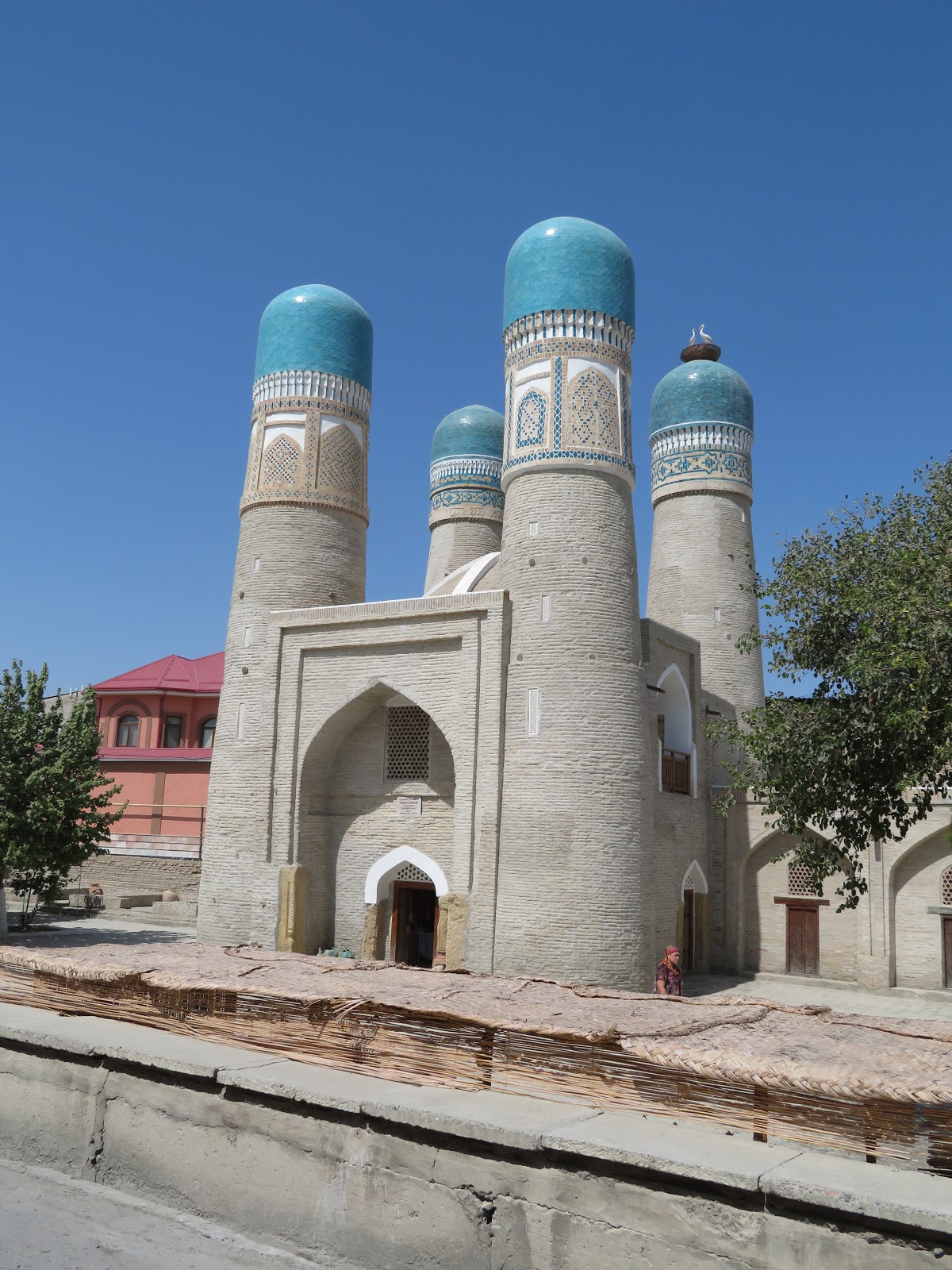
Our next visit was to Chor Minor.  It looked like an upturned stool.
It was built in 1807.  The name means "four minarets", although they are not minarets in the usual sense of the word.  It was the gate-house to a madrassah, that has now gone. 
The inside has been whitewashed and is now used as yet another place to buiy souvenirs.  However Sanjar told me that if I walked around the back, I would see some original inscriptions.  So I did.

Then it was lunchtime.  BL and I went back to the restaurant across the road from our hotel. BL had  chicken - or lamb?

and I had to try the ice-cream.  The "fork" is decorative - cocoa shaken over a fork.